
Know Your Enemy
Mosquito Biology & Our Approach
Most companies spray adult mosquitoes and call it done. We go after the source — and we do it in a way that's safe for your kids, your pets, and the pollinators in your yard.
Why Most Mosquito Treatments Don't Last
Adult mosquitoes make up a tiny fraction of the total mosquito population on your property at any given time. The vast majority are eggs, larvae, and pupae developing in standing water — completely unaffected by spraying adults.
A company that only sprays for adults will knock down the population temporarily, but within days new adults are emerging from the water on your property and migrating in from neighboring areas. Without addressing the source, you're on a treadmill.
Mosquito Biology
The 4-Stage Life Cycle
Understanding the life cycle is the key to effective control. Mosquitoes go from egg to biting adult in as little as 7–10 days in warm Texas weather — which is why monthly treatment is critical from April through October.

Mosquito larvae develop in standing water — the most vulnerable and most treatable stage of the life cycle.
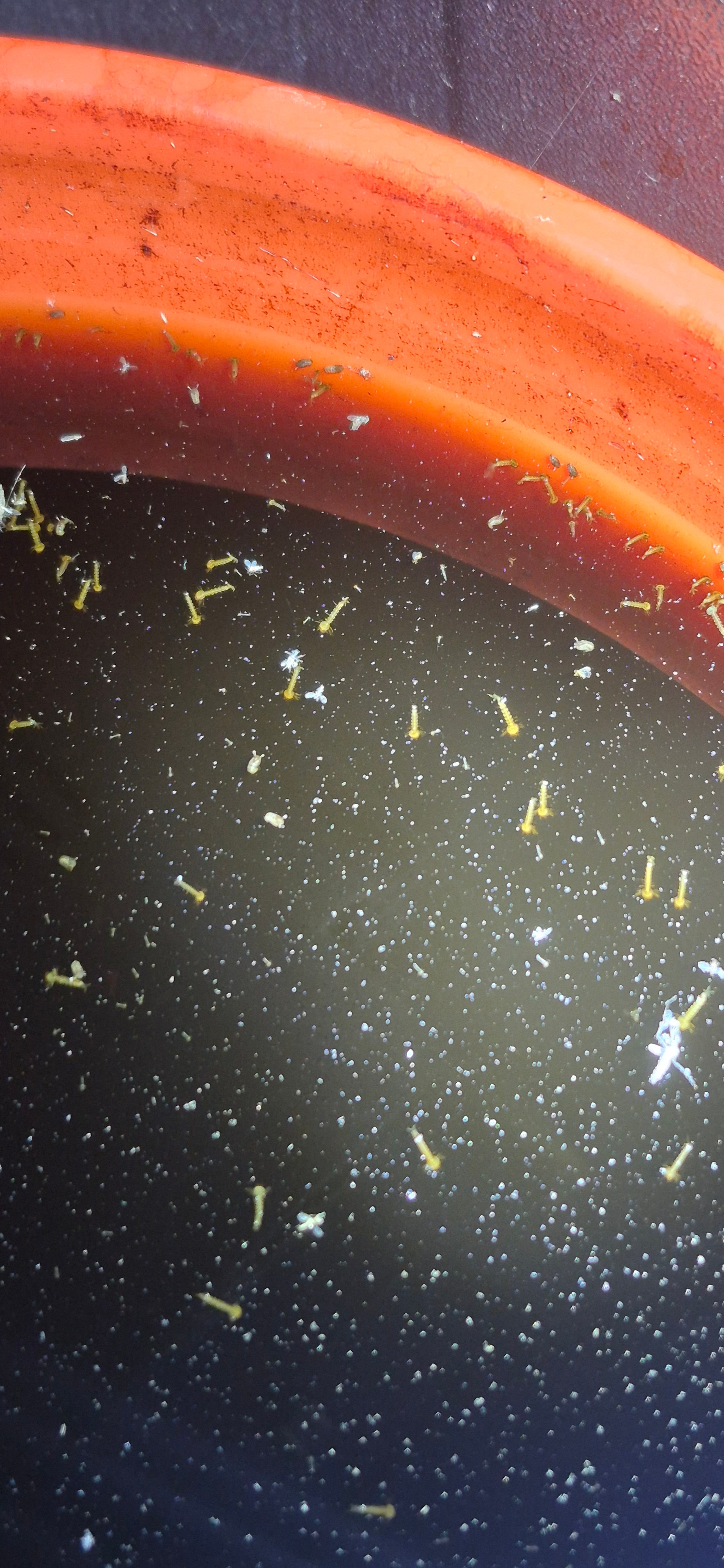
📍 Real photo taken at a customer's property in Anna, TX
This is what a single bucket of standing water can produce — hundreds of mosquito larvae, all within days of a female laying eggs. Every container that holds water is a potential breeding site. Empty them, flip them, or treat them before they become this.
The Female Mosquito: The Only One That Bites
Every mosquito bite you've ever received came from a female. Male mosquitoes feed exclusively on plant nectar and do not bite at all. The female must consume a blood meal before she can produce viable eggs — the proteins in blood are essential for egg development.
This is why targeting the egg-laying female is the most effective long-term strategy. Kill the female before she lays, and you eliminate 100–300 mosquitoes that would have hatched from that single batch of eggs. Our bucket traps exploit exactly this biology — they attract females looking for a place to lay, and eliminate them before the next generation ever begins.
Egg
1–3 days
Standing water surface
A female mosquito lays 100–300 eggs at a time directly on or near standing water. Eggs can survive drying out for months and hatch when re-wetted — which is why eliminating standing water is so critical.
Larva
4–14 days
Underwater, near surface
Larvae (wigglers) live entirely in water, feeding on microorganisms and organic matter. They breathe through a siphon tube at the water's surface. This is the most vulnerable stage — and the most effective point to intervene.
Pupa
1–4 days
Water surface
Pupae (tumblers) don't feed but remain active. They're completing their transformation into adults. Treating water at this stage is still effective before adults emerge.
Adult
2 weeks – 2 months
Vegetation, shaded areas
Adults rest in cool, shaded vegetation during the day and become active at dawn and dusk. Only females bite — they need a blood meal to develop eggs. Males feed only on nectar.
Where They Breed
Common Breeding Sites in Collin County Yards
A mosquito only needs a bottle cap of water to lay eggs. Here's what we look for — and what you can do between our visits to keep populations down.
Birdbaths
Change water every 3–4 days
Clogged gutters
Clean gutters regularly — they hold standing water
Flower pot saucers
Empty after rain or watering
Tarps and covers
Keep taut or remove so water doesn't pool
Old tires
Remove or drill drainage holes
Low spots in yard
Grade or fill to improve drainage
Children's toys
Store upside down or in a shed
Tree holes and stumps
Fill with sand or remove
Ornamental ponds
Add mosquito dunks or a fountain to keep water moving
AC condensate lines
Ensure proper drainage away from the home
How We Do It
Our 5-Step Approach
We don't just show up and spray. Every visit follows a systematic process designed to reduce mosquito populations at every stage of the life cycle — not just the adults you can see.
Step 1
Step 1: Find the Water
Before we spray anything, we walk the property looking for every source of standing water. Breeding sites you don't know about will undo any treatment. We identify them and give you a clear action list.
Step 2
Step 2: Larvicide Treatment
We apply BTi (Bacillus thuringiensis israelensis) — a naturally occurring soil bacterium — to standing water that can't be eliminated. BTi kills mosquito larvae specifically. It has no effect on bees, butterflies, birds, fish, pets, or people. It's approved for use in organic farming.
Step 3
Step 3: Mosquito Bucket Traps
We deploy and service mosquito bucket traps on every visit. These traps work by mimicking a perfect egg-laying site — attracting egg-laying females. The female enters, lays her eggs, and is killed in the process. Her eggs never hatch. This provides continuous long-term population reduction between treatments, targeting the one mosquito responsible for every single bite.
Step 4
Step 4: Targeted Adult Treatment
We treat the shaded vegetation, shrubs, and resting areas where adult mosquitoes hide during the day — not open lawn, not flowering plants, not areas where pollinators are active. Treatments are applied in the early morning or evening when bees are least active.
Step 5
Step 5: Barrier Protection
A residual barrier treatment is applied to the perimeter of the yard — fence lines, tree lines, and dense vegetation. This reduces adult populations between monthly visits and is applied in a way that minimizes drift and off-target exposure.
What Is BTi — and Why Do We Use It?
BTi (Bacillus thuringiensis israelensis) is a naturally occurring bacterium found in soil. When mosquito larvae ingest it, it's toxic to them — but it has absolutely no effect on bees, butterflies, dragonflies, birds, fish, mammals, or humans.
It's the same active ingredient used in Mosquito Dunks, which are approved for use in organic farming and certified safe for use in water sources where people swim, fish, and drink. The EPA has classified BTi as non-toxic to all non-target organisms.
We use it because it works — and because it's the right thing to do for the environment.
Peace of Mind
Safe for Your Family, Pets & Pollinators
We take this seriously. Here's exactly what we do — and don't do — to protect the things that matter in your yard.
Safe for Kids
We use EPA-registered products applied at label rates. Treated areas are safe for children once dry — typically 30–45 minutes after application. We'll always let you know before we treat.
Safe for Pets
Keep pets indoors during treatment and for 30–45 minutes after. Once dry, treated surfaces pose no risk to dogs or cats. We avoid treating pet water bowls, food areas, and pet resting spots.
Pollinator Protection
We do not treat flowering plants, open garden beds, or areas with active bee foraging. BTi larvicide has zero effect on bees, butterflies, or other beneficial insects. Adult treatments are timed and targeted to minimize any contact with pollinators.
Environmentally Responsible
We use the minimum effective amount of product needed to do the job. No blanket spraying of entire yards. No treatment of water features with fish or wildlife. Our goal is to reduce mosquitoes — not to saturate your property with chemicals.
Local Context
Mosquitoes in Anna & Collin County
North Texas mosquito season typically runs from April through October, with peak activity in June, July, and August when temperatures stay warm overnight and afternoon thunderstorms leave standing water everywhere.
The Anna and Melissa area has a number of creek drainages and low-lying areas that hold water after rain — ideal mosquito habitat. The rapid residential development in Collin County has also created a lot of new construction drainage issues, disturbed soil, and temporary water features that become breeding grounds.
The primary species we deal with in this area are Culex quinquefasciatus (Southern House Mosquito) and Aedes albopictus (Asian Tiger Mosquito). The Tiger Mosquito is particularly aggressive — it bites during the day, not just at dawn and dusk — and breeds in very small amounts of water, including bottle caps and leaf axils.
West Nile Virus is present in Collin County every year. Reducing mosquito populations around your home isn't just about comfort — it's a genuine public health measure.
Ready to Take Back Your Yard?
Monthly mosquito reduction — no contracts. Safe for kids, pets, and pollinators.